Navigating the crowded market for data transformation tools can feel overwhelming, especially for RevOps and analytics teams. Your goal is clear: turn raw data from sources like Salesforce, marketing automation platforms, and product databases into a clean, reliable, and unified source of truth in your warehouse, like Snowflake. The challenge isn’t just moving data; it’s about shaping it, cleaning it, and making it analytics-ready to drive revenue strategy.
This guide cuts through the noise. We’re here to help you find the best data transformation tools tailored specifically to the modern GTM data stack. We know you’re busy, so we’ve done the heavy lifting, evaluating the top platforms on the market to see how they stack up for real-world RevOps scenarios. Forget generic marketing fluff; this is a practical resource built on experience.
Inside, you’ll find a detailed breakdown of each tool, complete with screenshots and direct links. We’ll cover everything from key features like change data capture (CDC) and SQL/Python support to critical integrations with dbt and Snowflake. We’ll also provide an honest look at each tool’s pros, cons, pricing signals, and ideal use cases. By the end, you’ll have a clear understanding of which platform is the right fit, whether you’re a small team just starting out, an enterprise managing complex pipelines, or a dbt-first organization looking to optimize your workflow. Let’s find the perfect tool to untangle your technical debt and build a data foundation you can trust.
1. dbt Labs (dbt Cloud and dbt Core): The Standard for SQL-First Transformation
It’s nearly impossible to talk about the best data transformation tools without starting with dbt (Data Build Tool). As the de facto standard for transformation, dbt has fundamentally changed how analytics and RevOps teams approach data modeling. It cleverly applies software engineering best practices like version control, testing, and modularity directly to your data transformation workflows.
At its heart, dbt does one thing exceptionally well: it lets you transform data that’s already in your warehouse using just SQL SELECT statements. Instead of complex, hard-to-maintain scripts, your team can build reliable, repeatable data models collaboratively. This SQL-first approach makes it incredibly accessible for anyone on the RevOps or analytics team who knows SQL.
The open-source version, dbt Core, is a command-line tool that offers the full power of dbt’s transformation logic for free. For teams looking for a more managed experience, dbt Cloud provides a web-based UI, an integrated development environment (IDE), job scheduling, observability, and seamless Git integration. It handles the orchestration, so you can focus on building models, not managing infrastructure.
Why It Stands Out
What makes dbt unique is its “T-only” focus in the ELT (Extract, Load, Transform) paradigm. It doesn’t extract or load data; it specializes entirely in the transformation layer inside your cloud data warehouse (like Snowflake, BigQuery, or Redshift). This specialization allows it to integrate deeply with the modern data stack, empowering teams to build sophisticated, production-grade data pipelines with a skill set they already possess: SQL.
Use Case Snapshot: RevOps Funnel Reporting
A RevOps team can use dbt to join Salesforce Opportunity data with Marketo engagement records and product usage data from a production database. They can create a series of modular SQL models: one for cleaning lead data, another for staging opportunities, and a final one that materializes a unified fct_customer_journey table. This final table powers all their funnel conversion dashboards in a BI tool, ensuring every stakeholder sees the same, reliable numbers.
Pricing
- dbt Core: Completely free and open-source. You manage your own infrastructure and scheduling.
- dbt Cloud: Offers a free “Developer” tier for one user. Paid plans start with the “Team” plan at $100 per developer seat/month and scale to an enterprise tier with advanced security and governance features.
Website: https://www.getdbt.com/
2. Fivetran: Automated Data Movement Meets Integrated Transformation
While dbt owns the “T” in ELT, Fivetran has become a dominant force in the “EL” part, making it a critical player in any discussion about the best data transformation tools. Fivetran is a fully managed, automated data movement platform designed to reliably pull data from hundreds of sources into your cloud data warehouse with minimal engineering effort. It abstracts away the pain of maintaining brittle API connections and data pipelines.
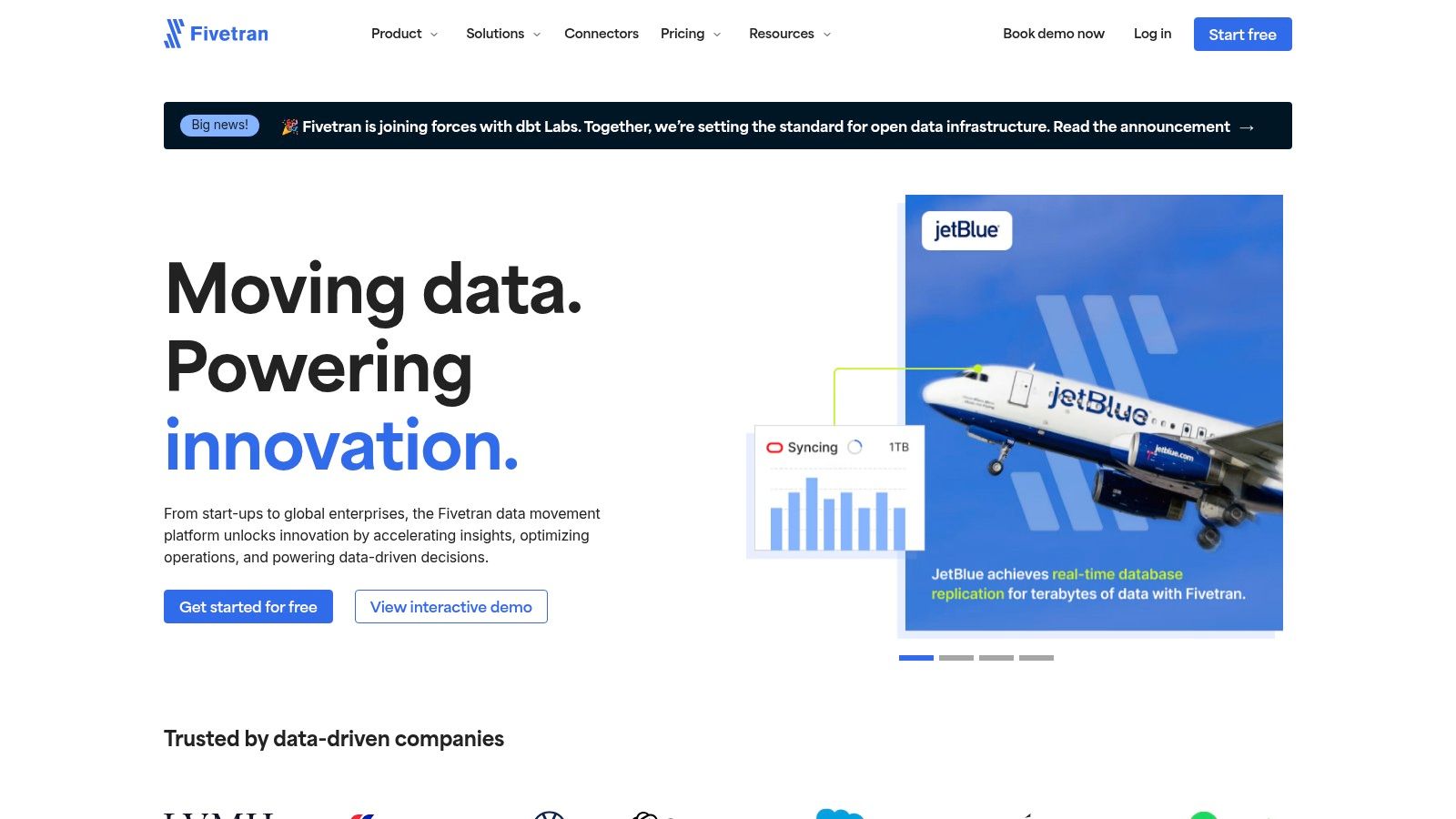
What makes Fivetran particularly relevant here is its tight integration with dbt. After Fivetran loads your raw data, it can automatically trigger your dbt Core projects to run transformations. This creates a seamless, end-to-end ELT pipeline orchestrated from a single place. Fivetran even offers pre-built dbt packages for popular sources like Salesforce and HubSpot, giving teams a massive head start on modeling their data for analysis. It simplifies the entire process, from extraction to analytics-ready tables.
Why It Stands Out
Fivetran’s core strength is its “set it and forget it” reliability for data extraction and loading. Its massive library of over 700 pre-built, fully managed connectors is unparalleled. For RevOps teams, this means connecting to Salesforce, Marketo, Google Ads, and Stripe is a matter of configuration, not coding. It handles schema changes automatically and uses efficient replication methods, which you can explore in this guide to Change Data Capture. The platform’s value is in its simplicity and the engineering hours it saves.
Use Case Snapshot: Unified Customer 360 View
A RevOps team uses Fivetran to pull data from Salesforce (CRM), Zendesk (Support), and Stripe (Billing) into Snowflake. Once the data lands, Fivetran triggers a dbt project that cleans, joins, and aggregates the information into a single dim_customers table. This table provides a holistic view of each customer, including their sales history, support ticket volume, and subscription status, powering everything from retention analysis to upsell opportunity scoring in their BI tool.
Pricing
- Fivetran’s pricing is consumption-based, calculated on Monthly Active Rows (MAR), which are the number of unique primary keys moved per month.
- It offers a 14-day free trial. Plans scale from a free tier (up to 500k MAR) to Standard, Enterprise, and Business Critical tiers, which offer faster syncs, greater security, and dedicated support.
Website: https://www.fivetran.com/
3. Matillion (Data Productivity Cloud): Visual-First Cloud ETL
For teams who prefer a low-code, visual interface for building data pipelines, Matillion presents a compelling alternative to code-heavy frameworks. Positioned as a “Data Productivity Cloud,” it’s designed to handle the entire ETL/ELT process, from extraction and loading to complex in-warehouse transformations, all within a drag-and-drop environment. This makes it one of the more accessible best data transformation tools for teams with mixed technical skill sets.
Matillion is cloud-native, running directly within your data warehouse environment (like Snowflake, Redshift, or BigQuery) to leverage its processing power. This push-down approach means data doesn’t leave your secure cloud ecosystem for transformation, which is a major plus for performance and governance. While you build pipelines visually, Matillion is generating and executing SQL under the hood.
Why It Stands Out
Matillion’s strength lies in its balance of a user-friendly visual builder with powerful, enterprise-grade capabilities. It democratizes pipeline development, allowing RevOps analysts to build and manage workflows that might otherwise require a dedicated data engineer. Its graphical interface for orchestration and transformation is intuitive, yet it doesn’t sacrifice the ability to handle complex logic, joins, and aggregations.
Use Case Snapshot: RevOps Funnel Reporting
A RevOps team can use Matillion’s Salesforce connector to extract lead, contact, and opportunity data. They can visually design a job that cleanses this data, joins it with Google Ads cost data pulled from another connector, and loads the combined results into a staging table in Snowflake. A subsequent transformation job can then aggregate this data into a final rpt_marketing_roi table, all scheduled and monitored within the Matillion UI.
Pricing
- Matillion uses a credit-based consumption model, where you pay for Virtual Core “task hours” when your pipelines are running.
- It is available through cloud marketplaces (AWS, Azure, Google Cloud) and offers predictable annual packages.
- Plans are tiered for different needs, including Developer, Teams, and Scale editions, requiring some planning to right-size your credit purchase.
Website: https://www.matillion.com/
4. Informatica Intelligent Data management Cloud (Cloud Data Integration)
For enterprises operating in complex or highly regulated industries, Informatica offers a powerful, all-in-one platform that goes far beyond simple data transformation. As a long-standing leader in the data management space, their Intelligent Data Management Cloud (IDMC) provides a unified solution for integration, data quality, Master Data Management (MDM), and governance, making it a heavyweight contender among the best data transformation tools for large-scale operations.
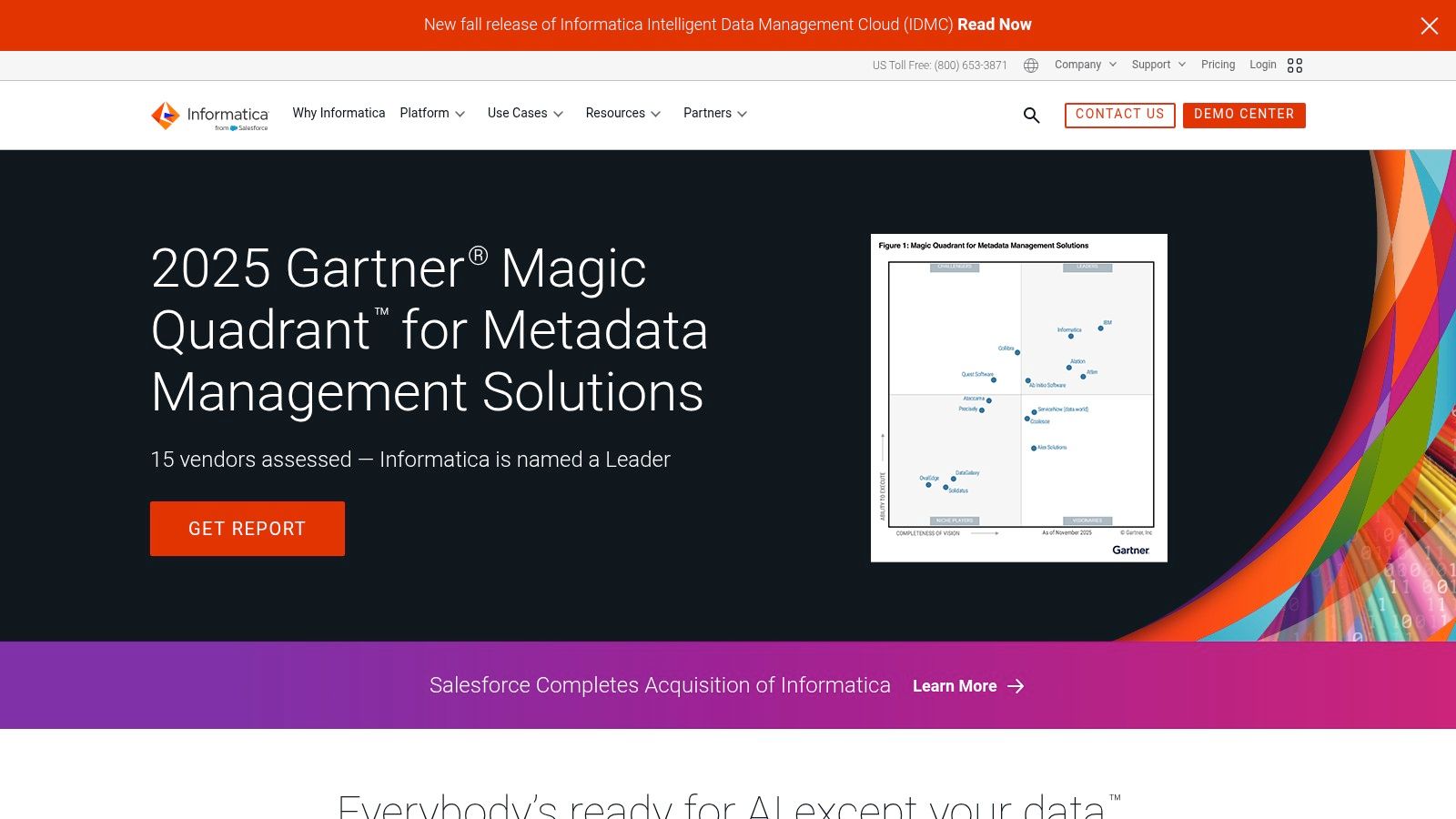
Unlike point solutions focused solely on transformation, Informatica’s strength lies in its breadth. Its Cloud Data Integration (CDI) service supports both high-volume ETL and ELT patterns, managed through a low-code/no-code interface. This allows teams to build sophisticated pipelines that not only move and transform data but also cleanse, govern, and master it within the same ecosystem, a critical requirement for industries like finance and healthcare.
Why It Stands Out
Informatica’s key differentiator is its enterprise-grade, unified platform approach. Where other tools might require you to stitch together multiple services for data quality, integration, and governance, Informatica provides these under one roof. Its consumption-based pricing model, based on Informatica Processing Units (IPUs), allows organizations to flexibly allocate budget across different data management tasks as needs evolve, from batch data integration to real-time API management.
Use Case Snapshot: Enterprise-Wide Customer 360
A large B2B enterprise can leverage Informatica to build a comprehensive Customer 360 view. The RevOps team could use CDI to pull data from Salesforce, SAP, and an on-premise order management system. They would then use Informatica’s Data Quality service to standardize addresses and de-duplicate contact records, and finally, use the MDM module to create a single golden record for each customer. This trusted master data then feeds into analytics platforms, ensuring all go-to-market teams operate from the same verified information.
Pricing
- Informatica uses a consumption-based model based on Informatica Processing Units (IPUs), which are purchased and then consumed by various services on the platform.
- Pricing is not publicly listed and requires a custom quote based on expected usage, services needed, and data volume. A 30-day free trial is available.
Website: https://www.informatica.com/
5. Talend (by Qlik) – Talend Data Fabric / Qlik Talend Cloud
For organizations seeking an all-in-one solution, Talend (now part of Qlik) offers a comprehensive suite that goes beyond just transformation. It’s an enterprise-grade platform combining data integration, quality, governance, and application integration into a single fabric. Unlike tools that focus solely on the “T” in ELT, Talend provides an end-to-end toolkit designed for complex, large-scale data operations across cloud, on-premise, and hybrid environments.
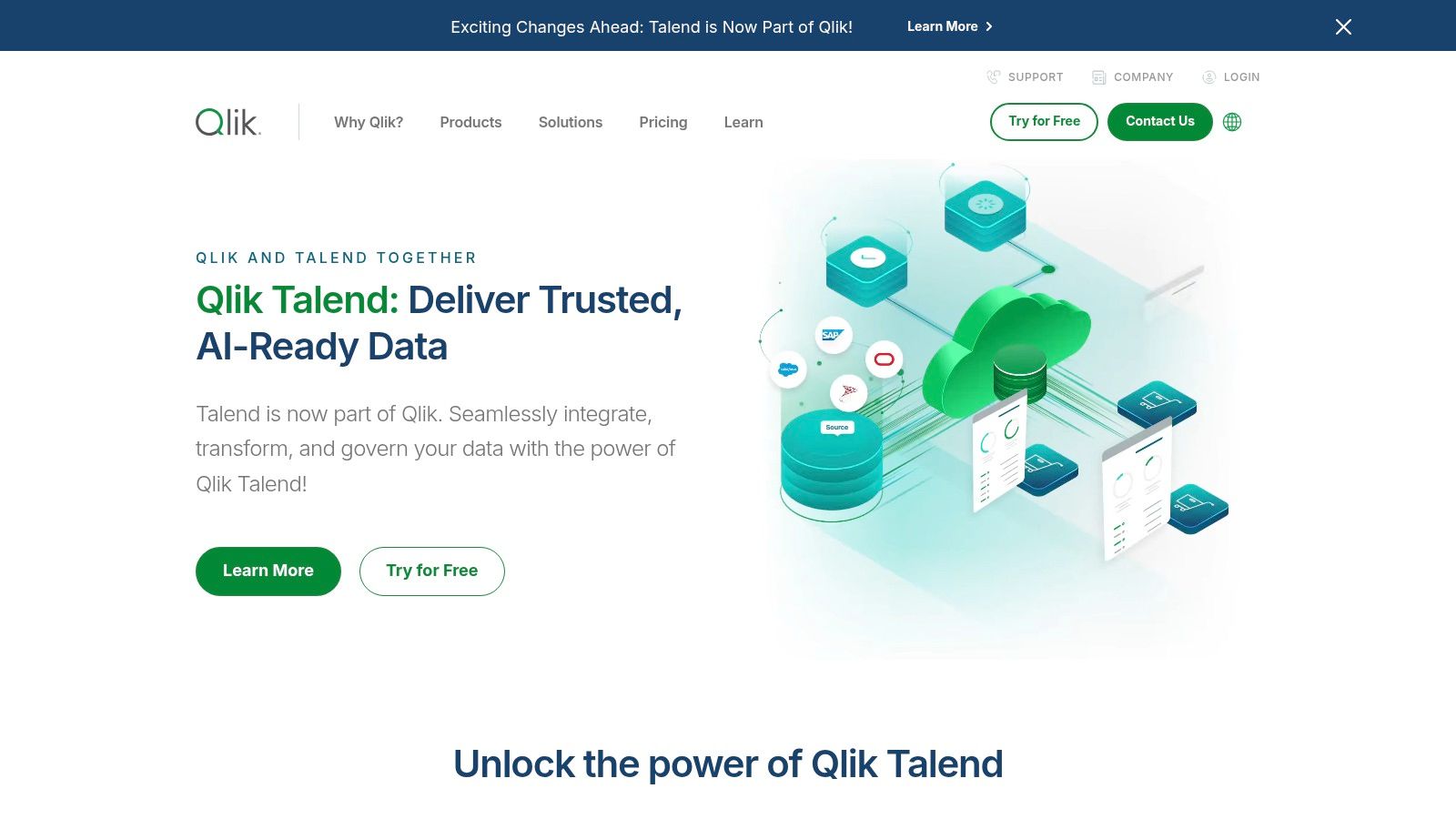
This unified approach means RevOps and data teams can manage the entire data lifecycle, from ingestion with a vast library of pre-built connectors to cleansing and standardization using its powerful data quality features. Its graphical interface allows users to build complex data pipelines visually, making it accessible to a broader range of technical skills beyond pure SQL or Python experts. This makes it a strong contender among the best data transformation tools for established enterprises.
Why It Stands Out
Talend’s key differentiator is its blend of extensive integration capabilities with robust, built-in data quality and governance. While many tools require you to stitch together different services for data profiling, cleansing, and masking, Talend includes these features natively. This allows teams to enforce data standards and build trust directly within their transformation pipelines, a critical function for enterprise-level compliance and security. Its flexibility to be deployed anywhere also meets strict data residency and security requirements that cloud-only tools cannot.
Use Case Snapshot: Enterprise Data Governance
A global RevOps team uses Talend to unify customer data from regional Salesforce orgs, SAP systems, and legacy on-premise databases. They build a pipeline that not only transforms and loads the data into Snowflake but also runs it through a data quality workflow first. This workflow automatically standardizes addresses, de-duplicates contacts using fuzzy matching, and masks sensitive PII. The result is a trusted, compliant “golden record” for each customer, powering global analytics.
Pricing
- Talend offers a free trial of its cloud platform.
- Pricing is primarily quote-based and tailored to specific usage, connectors, and deployment needs. You must contact Qlik/Talend sales for a custom quote.
Website: https://www.talend.com/
6. Alteryx (Designer Desktop and Alteryx Analytics Cloud)
A long-standing leader in the self-service analytics space, Alteryx empowers business analysts and RevOps professionals to perform complex data preparation and blending without writing a single line of code. Its visual, drag-and-drop workflow canvas, known as Alteryx Designer, is legendary for making sophisticated transformations accessible to non-technical users. This focus on “citizen data scientists” makes it a powerful choice for teams where analytics skills are distributed beyond a central data team.
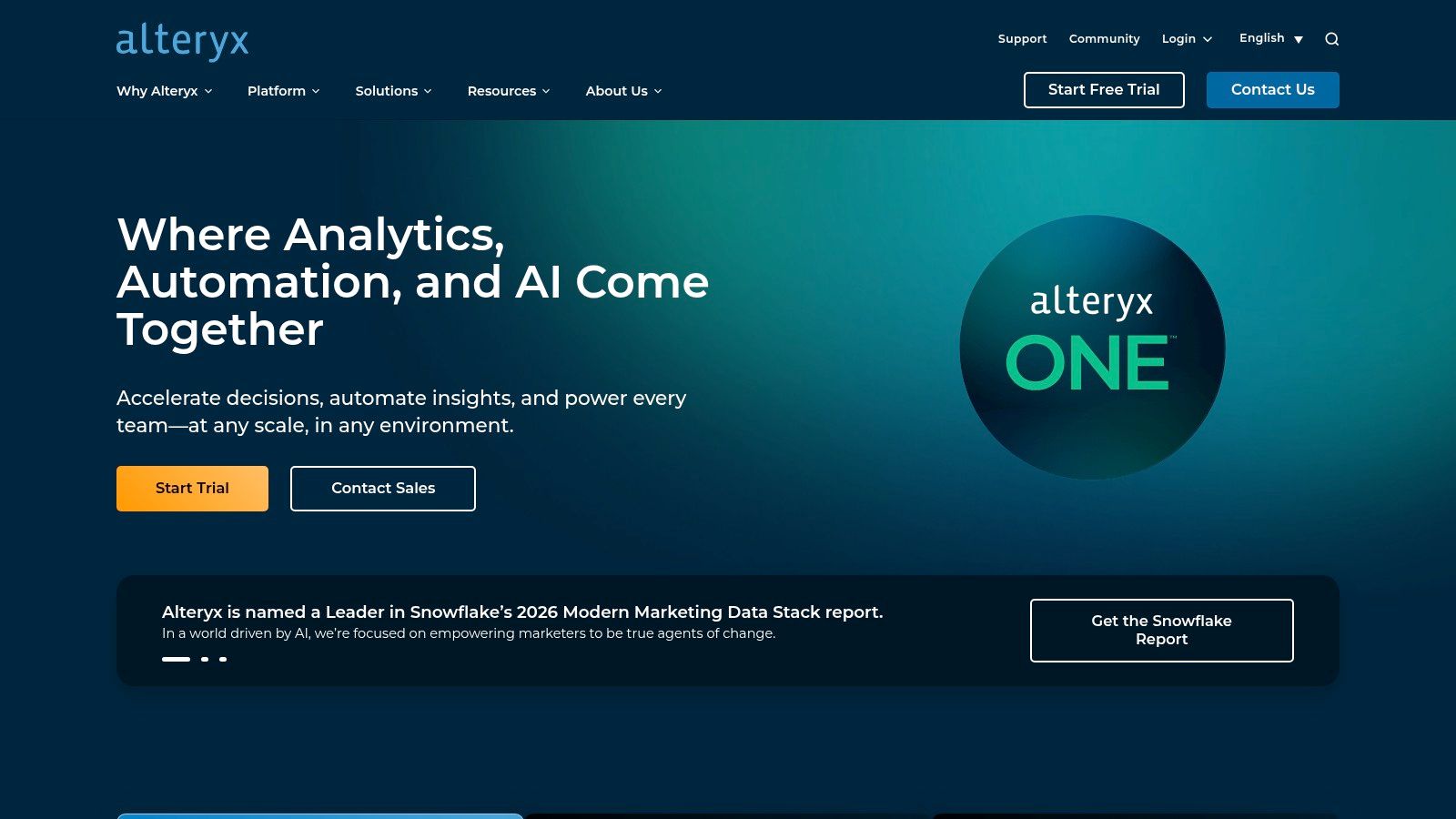
While the classic offering is the Designer Desktop tool, Alteryx has expanded into the cloud with its Alteryx Analytics Cloud Platform, bringing its user-friendly interface to a more modern, collaborative environment. It goes beyond pure transformation, incorporating spatial analytics, predictive modeling, and automated reporting into a single, unified platform. For teams looking for an end-to-end analytics solution, Alteryx remains one of the most comprehensive best data transformation tools available.
Why It Stands Out
Alteryx’s key differentiator is its incredible depth of no-code functionality combined with a vibrant, supportive user community. The platform offers hundreds of pre-built tools for everything from simple data cleansing to predictive modeling and geospatial analysis. If you can imagine a data manipulation task, there is likely an Alteryx tool for it. This allows analysts to build and iterate on complex logic incredibly fast, democratizing data preparation across the organization.
Use Case Snapshot: RevOps Territory Planning
A RevOps team can use Alteryx to blend Salesforce account data with third-party demographic data from a CSV file and internal product usage data from a database. Using the drag-and-drop interface, they can join these sources, cleanse address information, enrich accounts with demographic attributes, and use spatial tools to group them into balanced sales territories. The entire workflow can be automated to run weekly, outputting the results directly to a Tableau dashboard for sales leadership.
Pricing
- Alteryx Designer: Starts at $5,195 per user/year.
- Alteryx Analytics Cloud: Pricing is customized and quote-based, reflecting its enterprise focus. A free trial is available.
- The packaging can be complex, with separate licenses often required for automation (Server) and other advanced capabilities.
Website: https://www.alteryx.com/
7. AWS Glue (and Glue DataBrew)
For teams deeply embedded in the Amazon Web Services ecosystem, AWS Glue stands out as a powerful, serverless data integration service. It’s designed to discover, prepare, and combine data for analytics, machine learning, and application development. Glue automates much of the heavy lifting involved in data extraction, transformation, and loading (ETL), making it a cornerstone for many cloud-native data pipelines.
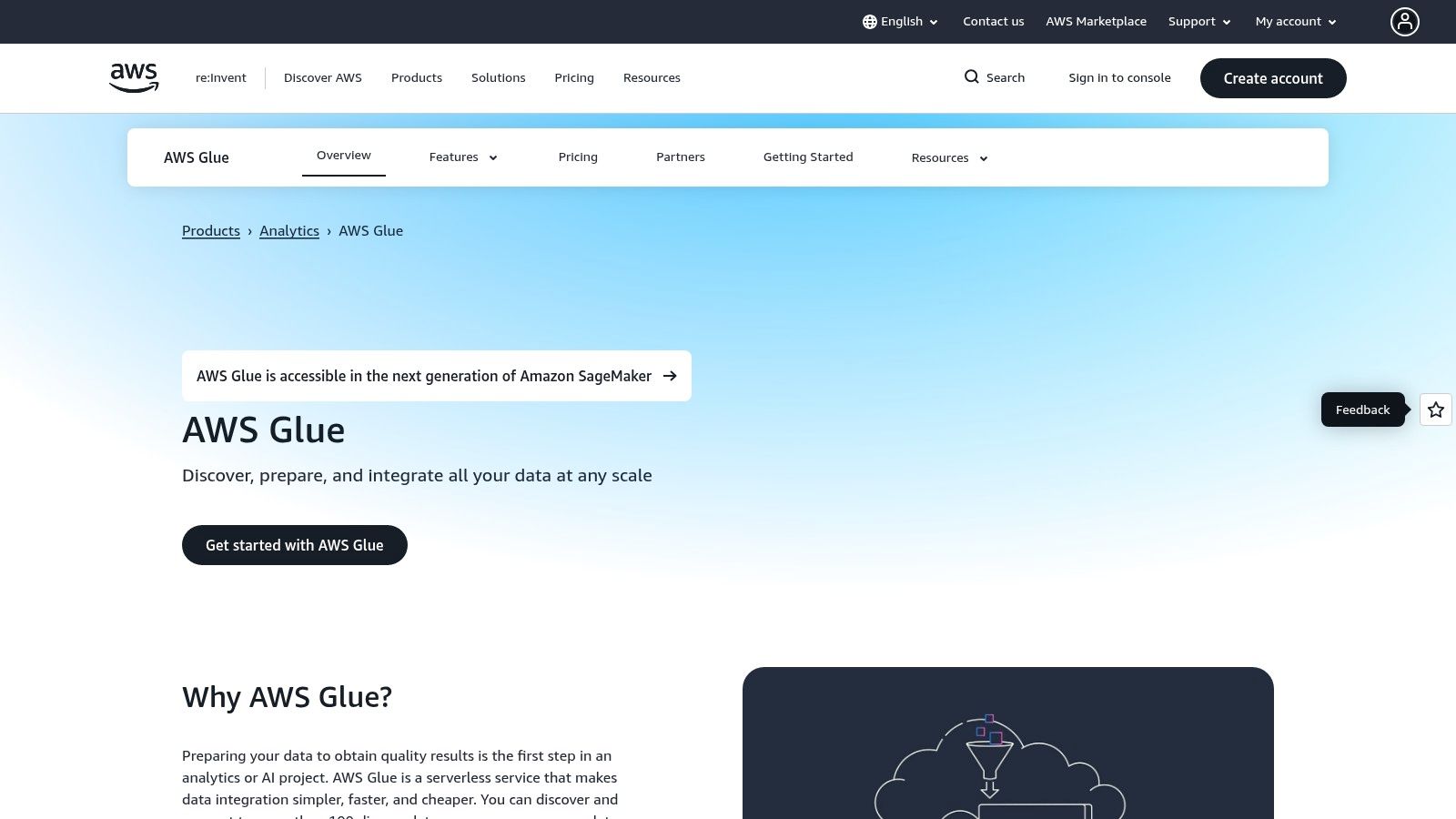
At its core, AWS Glue is a fully managed environment built on Apache Spark. It allows you to run Python or Spark jobs without provisioning or managing servers. For less technical users, the ecosystem includes AWS Glue DataBrew, a visual data preparation tool that enables cleaning and normalizing data with a no-code, point-and-click interface. This dual approach makes it one of the more versatile best data transformation tools for teams with mixed technical skill sets.
Why It Stands Out
Glue’s primary advantage is its native, seamless integration with the entire AWS analytics stack. It works effortlessly with S3 for data storage, Redshift for warehousing, and Athena for ad-hoc querying. The central Glue Data Catalog acts as a persistent metadata store for all your data assets, making them discoverable and queryable across services. This tight-knit ecosystem simplifies architecture and reduces the friction of moving data between different AWS services, all under a consumption-based pricing model.
Use Case Snapshot: RevOps Funnel Reporting
A RevOps team can use AWS Glue crawlers to automatically discover the schema of raw Salesforce data landed in an S3 bucket. They can then author a Glue ETL job in Python to cleanse this data, join it with user activity logs from another S3 source, and aggregate key funnel metrics. The transformed, analytics-ready dataset is then loaded into Amazon Redshift, where it can be queried by BI tools to build real-time performance dashboards for the sales and marketing teams.
Pricing
- Pay-as-you-go: Glue charges per second for the resources (Data Processing Units, or DPUs) used. Costs vary for ETL jobs, crawlers, and DataBrew sessions.
- No upfront costs: There are no minimum fees or startup costs; you only pay for what you use, which requires careful monitoring and cost modeling.
Website: https://aws.amazon.com/glue/
8. Azure Data Factory: Cloud-Scale Integration for the Microsoft Ecosystem
For teams deeply invested in the Microsoft Azure cloud, Azure Data Factory (ADF) is a powerful, fully-managed data integration service that handles the entire ELT process. It’s less of a focused transformation tool and more of a comprehensive data orchestrator, capable of everything from simple data movement to complex, code-free transformations at scale. ADF is Microsoft’s answer to building and managing data pipelines in the cloud.
ADF allows you to visually design and schedule data-driven workflows, called pipelines. These pipelines can ingest data from a vast array of on-premises and cloud sources, transform it using scalable “Mapping Data Flows” that run on managed Apache Spark clusters, and load it into destinations like Azure Synapse Analytics or Azure SQL Database. Its strength lies in its native integration with the entire Azure suite.

Why It Stands Out
What makes Azure Data Factory one of the best data transformation tools is its hybrid data integration capability and its “lift-and-shift” pathway for legacy systems. The self-hosted Integration Runtime allows you to securely execute data movement and transformation activities between cloud and on-premises data stores. Furthermore, its ability to run existing SQL Server Integration Services (SSIS) packages in the cloud provides a seamless migration path for organizations modernizing their data infrastructure without a complete rewrite.
Use Case Snapshot: RevOps Hybrid Data Consolidation
A RevOps team at a company using Microsoft Dynamics 365 and an on-premises SQL Server for billing can use ADF to create a unified customer view. A pipeline can be configured to copy the on-premises billing data into Azure Blob Storage. From there, a Mapping Data Flow can join this data with customer records from Dynamics 365, clean and aggregate it, and finally load the transformed data into Azure Synapse Analytics to power Power BI dashboards for sales performance and churn analysis.
Pricing
- Pay-as-you-go: Pricing is granular and based on usage, which can be complex. You pay for pipeline orchestration runs, data flow cluster execution time, the number of data integration units (DIU) used for copy activities, and operational charges.
- SSIS Integration: Billed separately based on the vCore hours for the managed SSIS runtime.
Website: https://azure.microsoft.com/en-us/products/data-factory/
9. Google Cloud Dataform: The Native BigQuery Transformation Engine
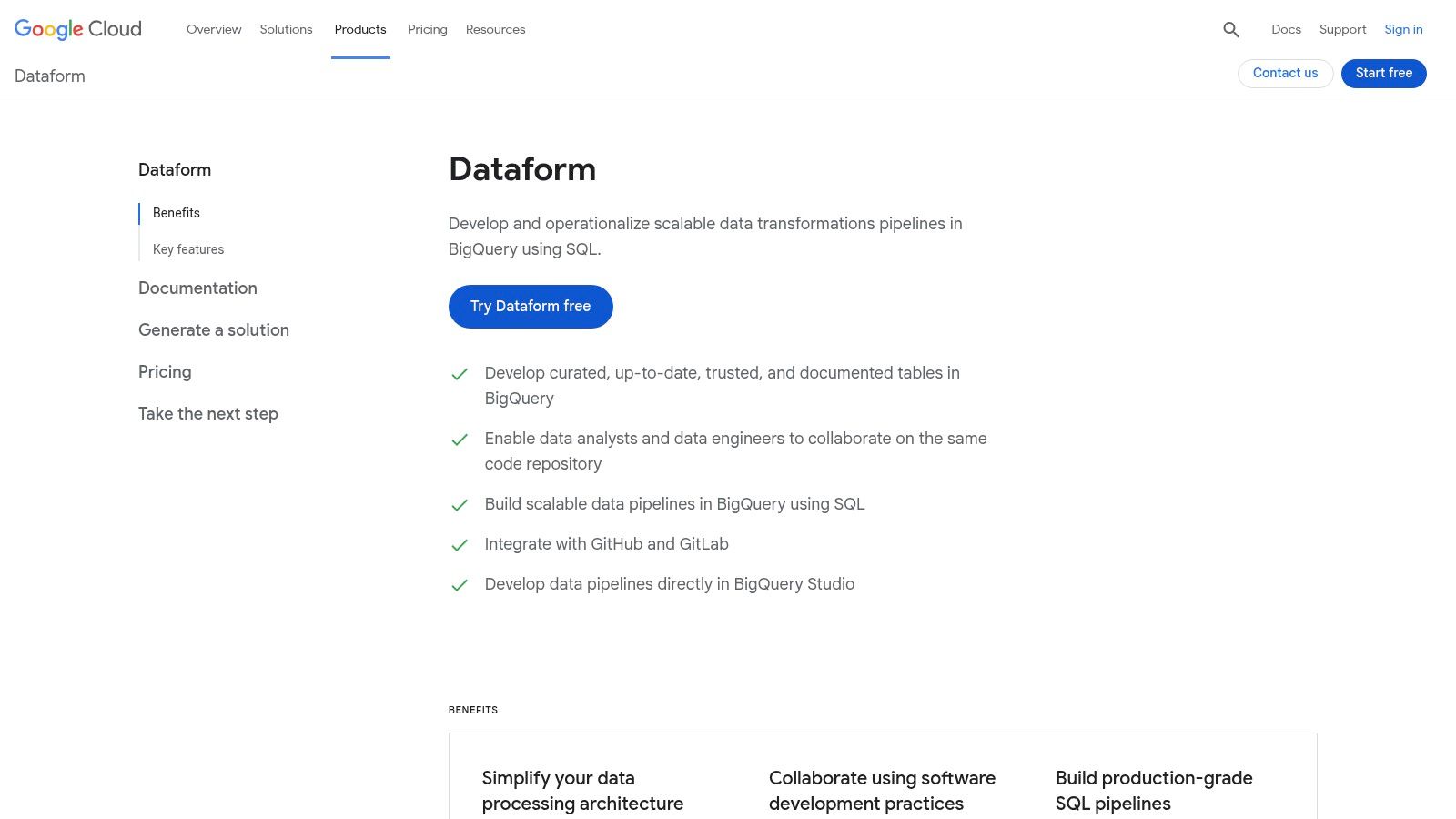
For teams fully invested in the Google Cloud ecosystem, Dataform offers a compelling, integrated solution for data transformation. Acquired by Google and now a native part of BigQuery, Dataform is a serverless service designed to help data teams develop, test, version control, and schedule complex SQL-based data transformation workflows directly within Google Cloud. It’s essentially Google’s answer to dbt, but tailored specifically for BigQuery users.
Dataform allows you to define your entire data pipeline as code using an enhanced version of SQL called SQLX. This file format allows you to embed metadata, data quality tests, and documentation directly within your transformation scripts. The platform provides a web-based IDE, visual DAGs to understand dependencies, and seamless integration with Git for version control, bringing software engineering discipline to your BigQuery transformations.
Why It Stands Out
What makes Dataform a standout choice is its tight, native integration with BigQuery. As a managed Google Cloud service, it requires zero infrastructure setup. This deep integration simplifies permissions, orchestration, and monitoring, as everything lives under the familiar GCP umbrella. For RevOps teams already using BigQuery as their central warehouse, Dataform provides the most streamlined, cost-effective path to building governed and repeatable data models without adding another third-party vendor to their stack. It’s one of the best data transformation tools for a pure GCP environment.
Use Case Snapshot: Marketing Attribution in BigQuery
A marketing operations team uses Google Analytics 4, which streams raw event data directly into BigQuery. They can use Dataform to build a series of SQLX models that transform this raw event data. One model cleans and sessions the data, another joins it with Google Ads cost data (also in BigQuery), and a final model creates an aggregated fct_marketing_attribution table. This entire workflow is scheduled to run daily, providing a fresh, reliable dataset for Looker Studio dashboards.
Pricing
- Dataform Service: The Dataform service itself is completely free to use within Google Cloud.
- Execution Costs: You only pay for the underlying Google Cloud resources used, primarily BigQuery compute and storage for running your jobs, plus any costs for Cloud Logging or other integrated services.
Website: https://cloud.google.com/dataform
10. Databricks (Delta Live Tables / Lakeflow Declarative Pipelines)
Databricks offers a unified data and AI platform where transformation is a core, engineering-driven capability. While known for large-scale data processing, its Delta Live Tables (DLT), now part of Lakeflow Declarative Pipelines, provide a powerful framework for building reliable ETL pipelines. It stands out by allowing teams to define data flows declaratively in SQL or Python, handling both streaming and batch data seamlessly.
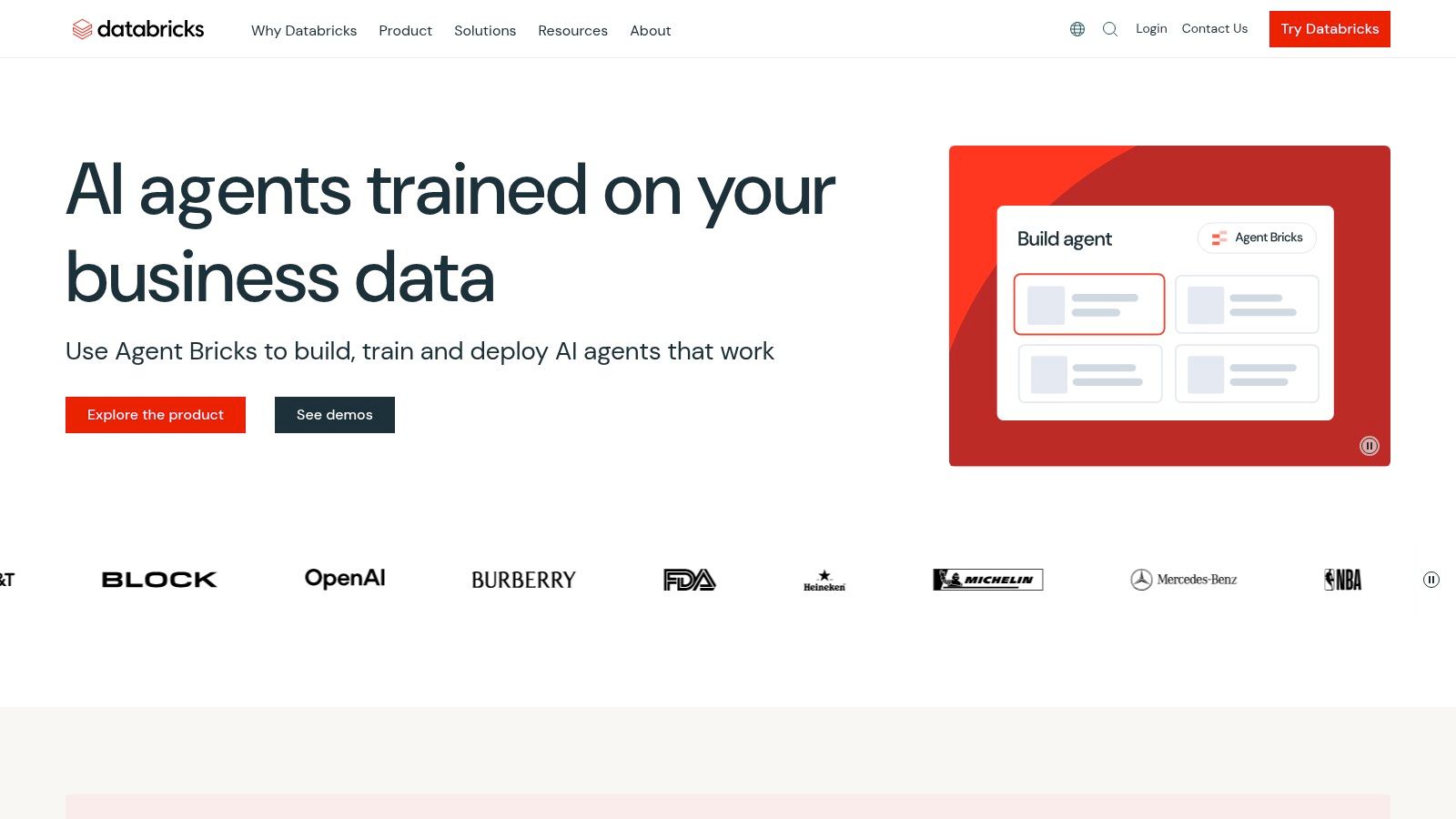
Unlike tools focused purely on the “T” in ELT, Databricks provides an end-to-end environment. DLT simplifies the complexity of Spark by automating infrastructure management, data quality monitoring, and error handling. This makes it one of the best data transformation tools for teams that need production-grade, streaming capabilities without the steep operational overhead of managing a Spark cluster manually.
Why It Stands Out
What makes Databricks unique in this context is its “data-as-code” approach to ETL. With DLT, you define the end state of your data pipelines and the quality constraints (expectations), and the platform figures out the execution, optimization, and recovery. This declarative model is especially powerful for complex, multi-stage pipelines that mix real-time streaming data with batch updates, all within a unified lakehouse architecture.
Use Case Snapshot: RevOps Anomaly Detection
A RevOps team can leverage DLT to build a real-time pipeline that ingests data from Salesforce change data capture (CDC) streams and product usage logs. They can define expectations to automatically flag or quarantine records with data quality issues, such as a deal closing with a value far outside the normal range. This pipeline can then feed a machine learning model for tasks like predicting customer churn, ensuring the model is trained on clean, up-to-the-minute data.
Pricing
- Pricing Model: Pay-as-you-go based on Databricks Units (DBUs), which vary by the service and cloud provider.
- Tiers: Offers multiple tiers (Standard, Premium, Enterprise) with different features. Committed-use discounts are available.
- Serverless Options: Serverless compute for jobs and DLT helps manage costs by abstracting away cluster management.
Website: https://www.databricks.com/
11. G2 – ETL Tools Category: The Crowd-Sourced Starting Point
Sometimes the best tool isn’t a single platform but a resource for discovery, and that’s where G2’s ETL Tools category shines. While not a transformation tool itself, it’s an indispensable starting point for any RevOps or analytics leader tasked with finding the right solution. G2 aggregates user reviews, ratings, and detailed comparison grids, providing a real-world pulse on what practitioners actually think about different vendors.
Instead of relying solely on marketing materials, you can filter through hundreds of the best data transformation tools based on company size, user satisfaction, and specific features. This peer-driven insight is invaluable for creating a vendor shortlist, understanding common pain points, and discovering rising stars in the data space that might not have a massive marketing budget but solve a niche problem perfectly.
Why It Stands Out
What makes G2 essential is its role as a neutral, crowd-sourced aggregator. It centralizes user sentiment, allowing you to quickly compare a modern ELT tool like Fivetran against an enterprise-grade platform like Informatica and a newcomer in the same view. While you need to be mindful of sponsored placements, the sheer volume of genuine reviews provides a powerful signal for market validation and user experience that you can’t get from a vendor’s website alone.
Use Case Snapshot: Vendor Shortlisting
A Head of RevOps needs to find a new ELT tool that has strong Salesforce and Snowflake connectors and is easy for a small team to manage. They use G2 to filter the ETL category for platforms highly rated by mid-market companies. By reading recent reviews, they identify three promising vendors, note common complaints about a fourth, and discover a lesser-known tool praised for its excellent customer support, which they add to their evaluation list.
Pricing
- For Users: Completely free to browse reviews, compare products, and access reports.
- For Vendors: Varies based on profile upgrades, lead generation services, and sponsored placements.
Website: https://www.g2.com/categories/etl-tools
12. AWS Marketplace – Data Integration & Pipelines
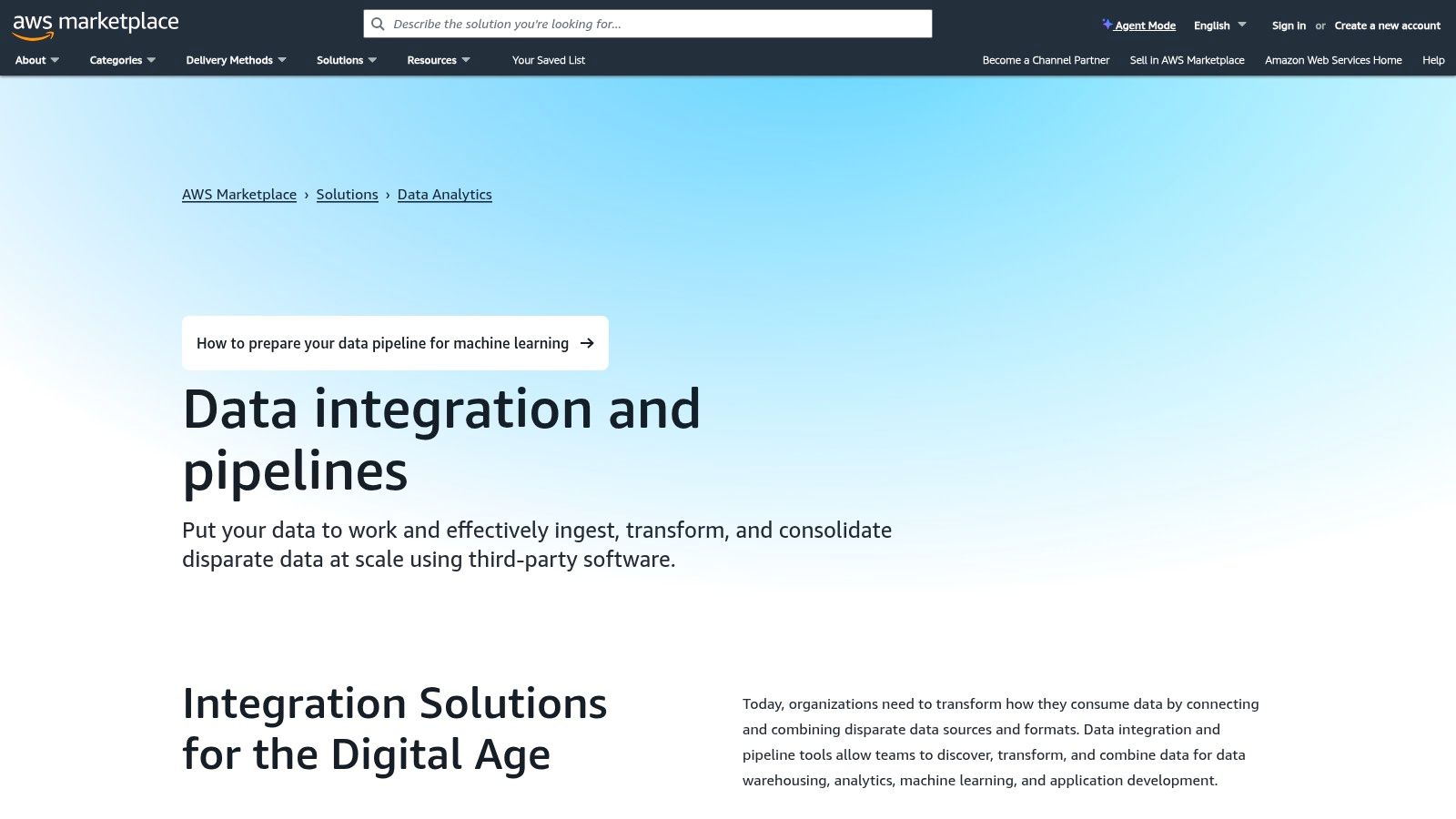
While not a data transformation tool itself, the AWS Marketplace is a critical resource for any team building their stack within the Amazon Web Services ecosystem. Think of it as a specialized app store where you can discover, purchase, and deploy many of the best data transformation tools directly from your AWS account. It streamlines procurement, simplifies billing, and often shortens the lengthy vendor onboarding process.
For RevOps teams already operating on AWS, this is a game-changer. Instead of managing separate contracts and invoices for tools like Matillion, Informatica, or Talend, you can consolidate everything under your existing AWS bill. This centralizes spend management and can unlock private pricing offers, making it easier to get the tools you need approved and deployed quickly.
Why It Stands Out
What makes the AWS Marketplace unique is its deep integration into the AWS procurement and billing framework. It acts as an accelerator for acquiring data stack components. For companies standardized on AWS, it removes significant friction from the legal, security, and finance hurdles that typically slow down new software adoption. One-click trials and deployments get powerful tools into your team’s hands faster.
Use Case Snapshot: RevOps Vendor Procurement
A RevOps team needs a robust ETL tool to sync data from various sources into their Amazon Redshift warehouse. Instead of a multi-month procurement cycle, their data engineering lead browses the Data Integration & Pipelines category on AWS Marketplace. They find several suitable tools, launch a free trial for their top choice directly from the console, and get budget approval for a private offer that’s billed through their company’s existing AWS account, all within a few weeks.
Pricing
- Platform Access: Free to browse and use.
- Tool Pricing: Varies entirely by the vendor. The Marketplace supports various models, including free trials, bring-your-own-license (BYOL), hourly/annual subscriptions, and SaaS contracts. All charges are consolidated into your monthly AWS bill.
Website: https://aws.amazon.com/marketplace/solutions/data-analytics/data-integration-pipelines
Top 12 Data Transformation Tools Comparison
| Product | Core capability | Best for / Target audience | Strengths (UX & quality) | Pricing / Value proposition |
|---|---|---|---|---|
| dbt Labs (Cloud & Core) | SQL-first transformations, testing, docs | Analytics engineers, warehouse-centric teams | Git-native workflows, built-in tests & docs | Open-source Core; Cloud tiers by seats/jobs — scales with usage |
| Fivetran | Fully managed ELT + 700+ connectors, CDC | Teams needing fast, low-maintenance ingestion | Rapid time-to-value, SLA-backed connectors | Consumption (Monthly Active Rows) — cost rises with volume |
| Matillion | Cloud-native ETL/ELT + visual authoring | Cloud DWH teams wanting visual pipelines | Predictable packages, visual pipeline builder | Credit/task-hour pricing; editions for scale |
| Informatica IDMC | Enterprise integration, data quality, MDM | Regulated / large enterprises with governance needs | Broad feature set, strong governance & MDM | Consumption via IPUs; enterprise licensing and planning |
| Talend (Qlik) | Integration + data quality, hybrid deploys | Teams needing data quality + deployment flexibility | Strong quality tooling, wide connector catalog | Sales-led pricing; cloud/on‑prem/hybrid options |
| Alteryx | No/low-code data prep, blending, analytics | Analysts and citizen data scientists | Fast analyst workflows, rich operator library | Published starter pricing; enterprise tiers via sales |
| AWS Glue (+ DataBrew) | Serverless ETL, metadata catalog, no-code prep | AWS-native analytics teams | Native AWS integrations, pay-as-you-go serverless | Per-second DPU billing; costs vary by region/workload |
| Azure Data Factory | Orchestration, mapping data flows, SSIS | Microsoft ecosystem & hybrid scenarios | Strong hybrid/SSIS support, scalable orchestration | Pay-as-you-go; separate charges for runtimes/data flows |
| Google Cloud Dataform | BigQuery-native SQL modeling & scheduling | BigQuery-centric analytics teams | Free service, Git + SQLX models, lightweight governance | Service free; execution costs billed by BigQuery & GCP |
| Databricks (Delta Live Tables) | Declarative batch & streaming ETL, lakehouse | Engineering teams needing streaming + ML readiness | Production-grade streaming, quality checks, security | DBU-based pricing; mapping to cloud costs can be complex |
| G2 – ETL Tools Category | Crowdsourced reviews & comparison marketplace | Buyers researching ETL/ELT vendors | User reviews, comparison grids, buyer resources | Free discovery; speeds vendor shortlisting |
| AWS Marketplace (Data Integration) | Procurement/catalog for ETL & pipelines | AWS customers procuring software/services | Consolidated billing, private offers, faster procurement | Vendor-specific pricing; simplifies AWS-based procurement |
Making Your Choice: Which Transformation Tool Is Right for You?
Whew, what a journey through the world of modern data transformation! We’ve unpacked everything from the SQL-centric universe of dbt to the all-in-one powerhouses like Fivetran and Matillion, and even peeked into the hyperscaler offerings from AWS, Azure, and Google. It’s clear that the days of monolithic, black-box ETL are numbered. The modern data stack is modular, transparent, and built for collaboration.
The core takeaway is this: the best data transformation tools are no longer just about moving data from point A to point B. They are about empowering teams to build reliable, testable, and maintainable data assets that drive real business value. The “T” in ELT has become the star of the show, demanding specialized tools that treat analytics code with the same rigor as application code.
Recapping Your Options: The Big Picture
Let’s boil it down. Your decision will likely pivot on a few key questions about your team’s current state and future goals.
- Is SQL the lingua franca of your data team? If so, a dbt-native or dbt-compatible tool is almost a non-negotiable starting point. dbt Cloud, Google Dataform, and tools with deep dbt integrations like Fivetran are your strongest contenders.
- How much control do you need? For teams wanting maximum flexibility and a free, open-source foundation, dbt Core is unbeatable. For those who prefer a managed, UI-driven experience with built-in scheduling and observability, dbt Cloud, Matillion, or Fivetran offer a faster path to productivity.
- Are you building from scratch or integrating with an existing enterprise ecosystem? Startups and small teams can find immense value and speed with a focused tool like dbt Cloud. Enterprises already invested in platforms like Informatica, Talend, or Databricks will find powerful, albeit more complex, solutions within those ecosystems.
- What is your team’s technical skill set? If your team is composed of analytics engineers who live in VS Code and Git, a code-first tool is a natural fit. If your team includes data analysts or RevOps specialists who are more comfortable with low-code or visual interfaces, a tool like Alteryx or AWS Glue DataBrew can democratize data preparation.
Actionable Next Steps for Your Team
Feeling analysis paralysis? Don’t worry. Here’s a simple framework to guide your next steps and help you select the right tool for your specific needs.
- Define Your Primary Use Case: Are you focused on transforming Salesforce data in Snowflake for RevOps reporting? Are you building complex data science features? Your primary goal will immediately narrow the field. For instance, a heavy CDC and RevOps focus might point you toward Fivetran, while building a lakehouse would steer you to Databricks.
- Audit Your Team’s Skills: Be honest about your team’s expertise. Choosing a Python-heavy framework for a team of SQL analysts will lead to a frustrating implementation. Pick a tool that meets your team where they are today, but has the ceiling to grow with them tomorrow.
- Run a Small, Focused Proof of Concept (POC): Don’t try to boil the ocean. Select one or two critical data models and build them out in your top two tool choices. Replicate a key business report or dashboard. This hands-on experience is worth more than a dozen sales demos.
- Evaluate the Whole-Life Cost: Look beyond the sticker price. Factor in implementation time, training, maintenance overhead, and the cost of what you’re not building while your team is bogged down with a complex tool. Sometimes, a higher-priced managed service is cheaper in the long run.
Ultimately, choosing from the best data transformation tools is about finding the right-sized key for your unique lock. Whether you’re a lean RevOps team aiming for agility or a large enterprise demanding robust governance, the perfect solution for you exists within this landscape. The key is to start with your people, your processes, and a clear vision of the business questions you need to answer.
Overwhelmed by the options and just need to get your Salesforce and Snowflake data pipeline working for your RevOps team? RevOps JET offers a fully managed, fixed-cost “Data-Team-as-a-Service” built on the best-in-class dbt and Fivetran stack. We handle the engineering so you can focus on driving revenue, not managing data infrastructure. Visit RevOps JET to see how we can help you build the data foundation you need in a fraction of the time.