When we talk about lead generation KPIs, we’re really talking about the specific numbers that tell you if your marketing is actually working to bring in new sales. They’re the metrics that cut through the noise and measure how effective you are at creating real opportunities.
It’s about moving beyond just counting leads and instead focusing on the quality and efficiency of your entire process.
Why Smart Lead Generation KPIs Matter
Welcome to your guide on building a smarter, more effective lead generation engine. If you’re tired of chasing vanity metrics that look great in a report but do absolutely nothing for the bottom line, you’ve come to the right place. We’re going to break down how to focus on the KPIs that directly tie your marketing spend to real revenue.
Think of it this way: you can cast a massive net and hope to catch something valuable, which is the old volume-based approach. Or, you can use the perfect bait in just the right spot to land the exact fish you want. That second approach is the heart of quality-focused, KPI-driven marketing.

Shifting From Busy To Profitable
The real goal here is to stop being busy and start being profitable. Solid lead generation KPIs act as your compass, pointing your strategy—and your budget—toward what actually works. They help you answer the tough questions that are critical for growth.
This is all about getting a clear, actionable picture of your performance by focusing on a few core metrics that truly move the needle. We’re going to dive deep into the essential concepts that form the backbone of any strong lead gen program:
- Marketing Qualified Leads (MQLs): Pinpointing prospects who’ve shown enough interest through their interactions with your marketing to be worth a closer look.
- Sales Qualified Leads (SQLs): Identifying the leads that your sales team has actually vetted and confirmed are ready for a direct sales conversation.
- Cost Per Lead (CPL): Measuring the financial efficiency of your campaigns to make sure you aren’t just burning cash to acquire leads.
To give you a quick overview, here’s a table summarizing the core KPIs we’ll be breaking down in this guide.
Essential Lead Generation KPIs at a Glance
A quick summary of the core KPIs we’ll cover in this guide, what they measure, and why they are critical for your business growth.
| KPI | What It Measures | Why It’s Important |
|---|---|---|
| MQLs & SQLs | The volume and quality of leads moving through your funnel. | Shows marketing’s contribution to the sales pipeline. |
| Conversion Rates | The percentage of leads advancing from one stage to the next. | Reveals bottlenecks and optimization opportunities. |
| Cost Per Lead (CPL) | The average cost to acquire a single new lead. | Directly measures the financial efficiency of your campaigns. |
| LTV:CAC Ratio | The lifetime value of a customer versus the cost to acquire them. | The ultimate indicator of long-term business profitability. |
Tracking these key metrics will help you build a more predictable and scalable growth machine.
By tracking these interconnected metrics, you move beyond guesswork. You create a system where marketing activities are directly accountable for their contribution to the sales pipeline and, ultimately, revenue.
Ultimately, a well-defined set of KPIs gives you the insights needed to refine your targeting, sharpen your messaging, and put your resources where they’ll have the biggest impact. When you understand the numbers behind your funnel, you can build a growth engine that’s both predictable and scalable.
For those ready to put this into practice, exploring various data-driven marketing solutions can provide a fantastic foundation for your strategy. This guide will give you the knowledge you need to make that transition smoothly.
So, What Are the Lead Generation Numbers That Really Matter?
To build a lead generation machine that actually works, you have to know what to measure. Think of your KPIs as the dashboard of your car. They tell you more than just if you’re moving; they show your speed, your fuel level, and whether the engine is about to overheat. They’re the vital signs of your marketing health.
Let’s dive into the essential metrics you absolutely need to be tracking.

We’ll start with the two big ones that define lead quality. I like to think of it like shoppers in a mall—not everyone who wanders in is actually looking to buy something today.
From Window Shoppers to Ready-to-Buy
First up, you have your Marketing Qualified Leads (MQLs). These are your window shoppers. They’ve shown some interest, maybe by downloading an ebook, joining a webinar, or clicking around your pricing page. They’ve basically raised a hand and said, “I’m curious,” but they’re not ready for a sales call just yet.
Then you have your Sales Qualified Leads (SQLs). These folks are the serious shoppers. They’ve moved past just browsing and are now asking a sales clerk for help or trying something on. An SQL is a lead your sales team has looked at and said, “Yep, this one is legit.” They have a real need, the budget to buy, and the authority to make the call.
That journey from MQL to SQL is where the magic happens (or doesn’t). It’s great to have a ton of MQLs, but if they never turn into SQLs, you’ve got a problem. It’s a classic sign of a disconnect between what marketing is promising and what sales actually needs.
Your MQL-to-SQL conversion rate is one of the most honest metrics you can track. It tells you if your marketing is attracting the right kind of people. If that number is low, it’s often because your definition of an MQL is way too broad, or your message simply isn’t hitting home with people who are ready to buy.
Keeping an Eye on the Bottom Line
Okay, so you’ve got leads sorted. But what about the money? You need to know if your efforts are financially sound. These next few KPIs connect your marketing spend directly to business results.
1. Cost Per Lead (CPL) This one is pretty straightforward. It’s the direct cost to get one new lead from a specific campaign. If you spend $1,000 on a LinkedIn ad and it brings in 100 leads, your CPL is $10. It’s perfect for judging how efficient a single tactic is.
2. Customer Acquisition Cost (CAC) Don’t mix this up with CPL! While CPL is about getting a lead, CAC is the total cost to land an actual paying customer. This number rolls up everything—ad spend, sales and marketing salaries, software costs—and divides it by the number of new customers you signed. This is the true price of winning business.
3. Customer Lifetime Value (LTV) LTV is the long game. It’s a projection of how much total revenue you can expect from a single customer over the entire time they do business with you. LTV is what tells you whether your CAC is sustainable. A high CAC might look scary on its own, but if the LTV is ten times higher, you’re in great shape.
These financial KPIs aren’t just for spreadsheets; they’re for making smarter decisions. High-performing teams obsess over metrics that track both lead volume and the quality of those leads. As you can read in this great piece on how lead generation metrics drive success on LanderLab.io, focusing on CPL and conversion rates is what ties marketing work directly to the bottom line, helping you know exactly where to put your budget for the best results.
Getting Your Hands Dirty: How to Calculate Your Most Important KPIs
Knowing which metrics matter is the first step, but the real magic happens when you can calculate them accurately. This is where high-performing teams pull away from the pack. It’s time to move from theory to practice and turn those abstract concepts into hard numbers that will actually guide your strategy.
Think of this as your recipe book for KPI lead generation. We’re laying out the exact ingredients and step-by-step instructions to measure the health of your funnel. No more guessing—just clear, data-driven decisions.
Calculating Your Funnel Conversion Rate
Your funnel conversion rate is the pulse of your lead generation engine. It shows you just how smoothly prospects move from one stage to the next. The best place to start is with your MQL to SQL conversion rate, as it’s the ultimate test of lead quality and the alignment between marketing and sales.
The formula itself is pretty simple:
(Total Number of SQLs / Total Number of MQLs) x 100 = MQL to SQL Conversion Rate (%)
So, if your marketing team generated 500 MQLs last quarter and sales accepted 40 of them as SQLs, your conversion rate is 8%. If that number feels low, it’s often a big red flag that marketing and sales aren’t on the same page about what a “good” lead really looks like.
Nailing Down Your Cost Per Lead
Next up is Cost Per Lead (CPL), the metric that keeps your marketing budget honest. It tells you exactly what you’re paying to get a single lead from a specific campaign or channel.
Here’s the breakdown:
Total Marketing Spend on Campaign / Total New Leads Acquired = Cost Per Lead ($)
Let’s say you put $5,000 into a Google Ads campaign that brought in 250 new leads. Your CPL for that specific campaign is $20. This number is your best friend when it comes to optimizing ad spend and shifting budget to the channels that are actually working.
For the data folks, calculating this means stitching together data from different places. You’ll likely need to pull ad spend from your advertising platforms and combine it with lead data from your CRM. Here’s a peek at what that could look like in a dbt model, joining Google Ads spend with lead info from Salesforce.
This kind of SQL transformation is what allows you to build a single source of truth for your marketing analytics, giving you a reliable way to calculate CPL across every single campaign.
The Ultimate Profitability Metric: LTV to CAC
The LTV:CAC ratio might just be the most important KPI for understanding the long-term health of your business. It pits the lifetime value of a customer (LTV) against what it cost you to get them (CAC). A healthy ratio, usually 3:1 or better, is a strong sign that you have a sustainable and profitable business model.
To get there, you first have to figure out each piece of the puzzle.
- Customer Lifetime Value (LTV): (Average Revenue Per Account) x (1 / Customer Churn Rate)
- Customer Acquisition Cost (CAC): (Total Sales & Marketing Costs) / (Number of New Customers Acquired)
Once you have both LTV and CAC, the final calculation is straightforward:
LTV / CAC = LTV:CAC Ratio
Let’s make this real. Imagine your average customer brings in $500 in revenue each month, and your monthly churn rate is 2%. Your LTV would be $500 / 0.02, which comes out to $25,000.
Now, let’s say your total sales and marketing spend for that period was $200,000, and you brought in 25 new customers. Your CAC would be $200,000 / 25, or $8,000.
In this scenario, your LTV:CAC ratio is $25,000 / $8,000, which is 3.125. This tells you that for every dollar you spend to win a customer, you can expect to get just over three dollars back. That’s a great sign of a healthy growth engine. While we’ve focused on marketing’s input here, you can see how these metrics feed into bigger business goals. To see how these numbers fit into the bigger picture, check out our guide on essential sales KPIs examples.
Building a Data Pipeline You Can Actually Trust
Your lead generation KPIs are only as good as the data feeding them. Seriously. Think of it like this: your KPIs are a high-performance engine, and your data pipeline is the fuel line. If that line is clogged with messy, unreliable data, your engine is going to sputter out. To get analytics you can bet your budget on, you need a solid data pipeline.
This whole process is about gathering information from all the different places your leads hang out and interact. We’re talking about your CRM, your marketing automation platform, all your ad networks, and even your own product database. The end goal is to stitch all that information together into a single, cohesive story of the customer’s journey.
It’s a simple flow in theory: get the raw data, run the numbers, and find the insight. But getting each step right is what separates guessing from knowing.
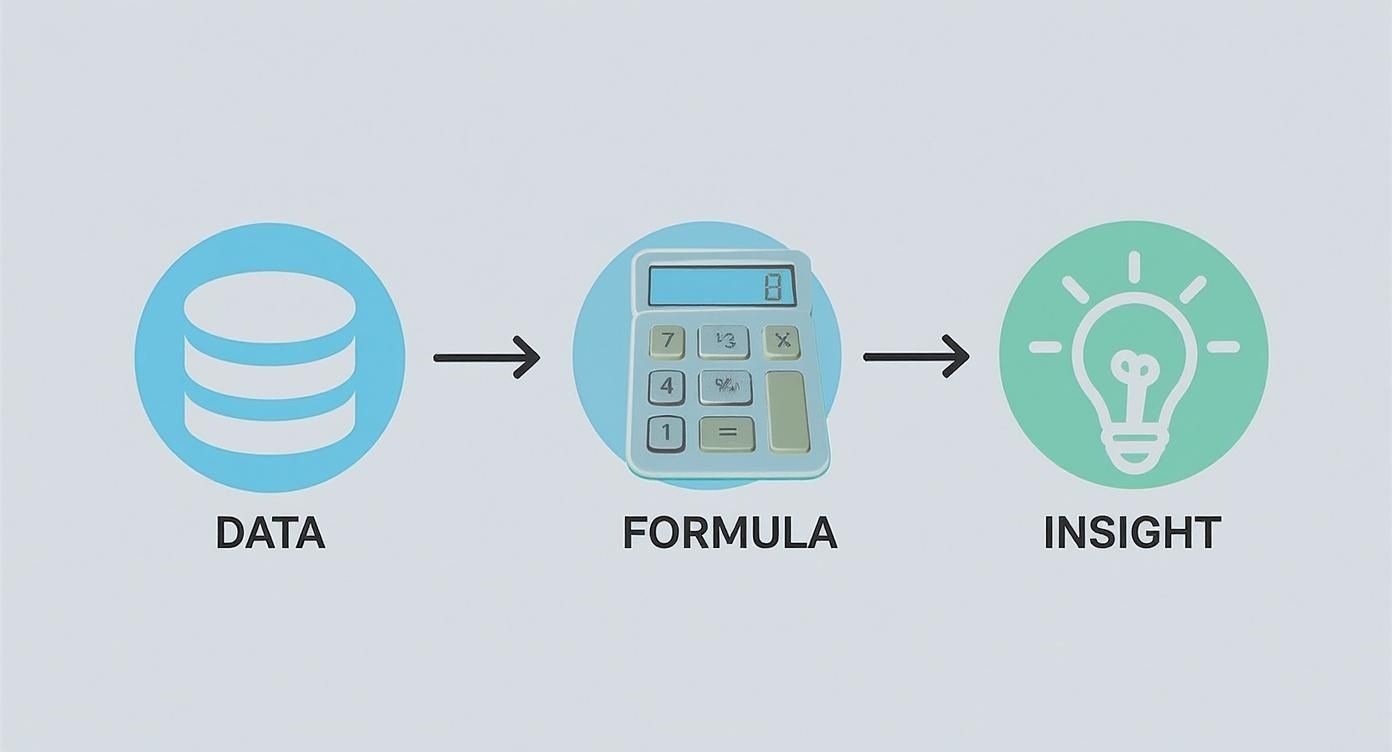
This little diagram nails it. You start with clean data, apply the right formulas, and then you get the “aha!” moments that actually guide your strategy.
Identifying Your Core Data Sources
First things first, you need to map out every single system that holds a piece of the lead gen puzzle. Each platform gives you a different angle on performance, and the magic happens when you bring them all together.
You’ll almost certainly need to connect these usual suspects:
- CRM Events: This is your source of truth for the sales funnel. Think lead creation, status changes from MQL to SQL, and the moment a deal gets stamped
Closed-Won. - Marketing Automation Tools: All those juicy engagement signals live here—email opens, link clicks, webinar attendance. This is what fuels lead scoring and tells you who’s actually interested.
- Ad Networks: To get a real CPL, you have to pull spend, impression, and click data straight from the source, like Google Ads, LinkedIn, and Facebook.
- Website Analytics: Tools like Google Analytics show you what people are doing on your site, where they’re coming from, and which forms they’re filling out.
Getting these systems talking to each other is the foundation of everything. If you want to go deeper on how this works, our guide on marketing automation integrations has some great practical advice for building a seamless tech stack.
The Three Pillars of Pipeline Construction
Okay, you’ve identified your sources. Now what? Building the actual pipeline comes down to three key stages. It’s like plumbing for your analytics—get these steps right, and clean water (or in this case, data) will flow without a hitch.
- Instrumenting Events: This is all about deciding exactly what user actions you need to track. Don’t just track everything for the sake of it. Be strategic. Zero in on the events that scream “intent,” like a “Request a Demo” button click or a visit to your pricing page.
- Ingesting Data: Next, you need to pull all that data from your different sources into one central spot. This is usually a data warehouse like Snowflake or BigQuery. Doing this creates a single source of truth, so everyone is working from the same numbers.
- Transforming Data: Raw data is a mess. It’s just a fact of life. The transformation stage is where you clean, model, and structure everything so it’s actually ready for analysis. This is where the real work happens—connecting an ad click to a form fill, and ultimately, to a brand new customer.
This structured approach is your best defense against bad data and ensures the numbers lighting up your dashboards are accurate and reliable.
Solving the Toughest Data Challenges
Even with a beautifully constructed pipeline, a couple of classic problems can still throw a wrench in your reporting: attribution and deduplication. These are the silent killers of trustworthy KPIs.
Multi-Touch Attribution is about figuring out how to give credit to the many marketing touchpoints a person interacts with before they convert. Was it that first blog post they read, the webinar they attended six weeks later, or the final retargeting ad that got them over the line? Without a clear model, you’re just guessing which channels are really worth the investment.
A great place to start is a U-shaped model. It gives 40% of the credit to the very first touchpoint, 40% to the touchpoint that led directly to the conversion, and spreads the remaining 20% across all the interactions in between. This approach rightly values both what started the journey and what closed it.
Lead Deduplication is just as important. It’s incredibly common for the same person to show up in your systems multiple times—maybe they downloaded an ebook last month and then signed up for a webinar today. If you count them as two separate leads, your lead volume is inflated and your CPL looks way better than it actually is. A solid dedupe process, usually based on a unique identifier like an email address, makes sure every person is only counted once. It’s the only way to get a true read on your reach and efficiency.
Setting Benchmarks and Alerts for Your KPIs
Tracking your lead generation KPIs is a huge step forward, but let’s be honest—the numbers by themselves don’t tell you much. Is a $50 Cost Per Lead (CPL) a win or a total disaster? Should you be celebrating an 8% MQL-to-SQL conversion rate? Without context, your data is just noise. This is where benchmarks and alerts come in, turning those raw numbers into something you can actually act on.
Think of it like driving. Your dashboard shows your speed, but it’s the speed limit signs on the road that give you the context to know if you’re going too fast or too slow. Benchmarks are your speed limits; they tell you what “good” looks like for your business.
Establishing Your Internal Baseline
The most important benchmarks are your own. Before you ever start looking at what other companies are doing, you need a solid grasp of your own historical performance. This internal baseline is your single source of truth for measuring progress.
Start by digging into your performance over the last six to twelve months. Looking at this data helps you set realistic targets for improvement.
- Seasonal Trends: Do your lead costs predictably spike during certain quarters? Knowing this ahead of time helps you budget smarter instead of getting caught off guard.
- Performance Ceilings: What was the best MQL-to-SQL rate you ever hit for a specific channel? That’s not just a nice memory—it’s a real, achievable target to aim for again.
- Progress Over Time: Tracking your month-over-month and quarter-over-quarter trends shows whether the strategic changes you’re making are actually paying off.
Setting internal benchmarks transforms your dashboard from a static report into a dynamic scoreboard. It’s about competing against your past self, making sure you’re always pushing for better results based on what you know is possible.
Comparing Against Industry Standards
Once you’ve got your internal baseline locked down, it’s incredibly helpful to see how you stack up against the wider industry. While every business is unique, these external numbers can help you spot major opportunities or flag areas where you might be lagging.
For example, understanding how different channels typically perform can seriously influence where you invest your marketing dollars. Performance benchmarks show that webinars pull in an average conversion rate of 2.3% in B2B, and leads from those registrations are 16% more likely to buy. On the other hand, account-based marketing (ABM) strategies often boast a 14% higher pipeline conversion rate, proving that highly targeted efforts can really boost lead quality. You can dive deeper into these lead generation statistics on DesignRush.com.
Transforming Your Dashboard with Proactive Alerts
Benchmarks tell you where you stand, but automated alerts tell you the moment something changes. This is the difference between reactive analysis and proactive management. Instead of finding out about a problem at the end of the month, you can jump on it right away.
Just imagine getting an instant Slack notification when:
- CPL Spikes: Your CPL for a key ad campaign suddenly jumps more than 20% in a single day.
- Conversion Rates Drop: Your MQL-to-SQL conversion rate falls below its three-month average.
- Lead Volume Dries Up: A landing page that was crushing it suddenly stops generating leads.
These kinds of alerts turn your KPI lead generation dashboard from a passive reporting tool into an active defense system for your revenue goals. They give your team the power to investigate and fix issues before they have a chance to throw off your entire quarter.
Where Lead Generation Measurement is Headed
The way we measure marketing is always changing, and lead generation is no exception. While the core metrics we’ve covered are the foundation of any good strategy, new tools and technologies are giving us a much sharper, more intelligent view of what’s working. Think of it less as replacing the old playbook and more like adding a whole new set of high-tech plays.
Leading the charge is Artificial Intelligence. AI is quickly moving past basic tasks and into the world of predictive analytics, which is completely reshaping how we find our best prospects.
AI and Predictive Lead Scoring
What if you could tell which leads were destined to become your best customers before sales even reached out? That’s the promise of predictive lead scoring. Instead of just looking at what a lead has done in the past, AI models sift through thousands of data points—everything from company size and industry to subtle website behaviors—to predict who is most likely to buy.
This allows your team to focus their energy with surgical precision, chasing the opportunities with the highest statistical chance of closing. It’s the closest thing we have to a crystal ball for the sales pipeline.
This isn’t some far-off concept; the market for these tools is booming. The entire lead generation solutions market is expected to balloon to over $32 billion by 2035, with AI and automation being huge drivers of that growth. And with 53% of B2B marketers already planning to use AI to get more efficient, it’s clear this is becoming the new standard. You can dig into more of these trends with these verified lead generation statistics at CallPage.io.
Tearing Down the Data Silos
Another huge shift is the move to finally connect all our different data sources. For years, marketing, sales, and product data have been stuck in their own separate worlds. The future is about bringing them all together for one complete picture of the customer journey.
We’re moving beyond just tracking a lead through the marketing funnel. The goal now is to understand the entire customer lifecycle, from the very first ad they saw to their long-term value and loyalty.
This unified view helps answer much bigger questions. You can finally figure out which marketing channels bring in customers who stick around the longest or which campaigns produce users with the lowest churn rates. While the technology makes it possible, the goal is still the same: using data to build better relationships and grow the business in a smart, sustainable way.
Got Questions About Lead Gen KPIs? We’ve Got Answers
Even with a perfect plan on paper, questions always pop up once you start getting your hands dirty with lead generation KPIs. Let’s tackle some of the most common ones that teams run into when they move from theory to practice.
What’s the Real Difference Between a Metric and a KPI?
This is a great question, and it’s easy to see why people get them mixed up. They’re often used to mean the same thing, but the distinction is actually pretty important.
Think of it like this: a metric is just a number. It’s any data point you can track, like how many people visit your website or open an email. It’s information, but it doesn’t necessarily tell you if you’re winning or losing.
A Key Performance Indicator (KPI), on the other hand, is a metric you’ve specifically chosen because it tells you how you’re doing against a major business goal. Website traffic is a metric. But the conversion rate of that traffic into MQLs? That’s a KPI, because it’s directly tied to your goal of getting more qualified leads in the door.
The simplest way to tell them apart is to ask yourself: “Does this number directly tell me if we’re succeeding at a core business objective?” If the answer is a clear “yes,” you’re looking at a KPI.
How Often Should We Be Looking at Our Lead Gen KPIs?
The right rhythm for checking your KPIs really depends on what you’re measuring and how long your sales cycle is. Some numbers need a daily check-in, while others only make sense when you look at them over a month or a quarter.
-
Daily or Weekly Checks: Things that can change quickly, like your Cost Per Lead (CPL) on a live ad campaign or a landing page’s conversion rate, need frequent monitoring. This is how you catch a problem—like a sudden ad spend spike—and fix it before it blows a hole in your budget.
-
Monthly or Quarterly Reviews: Your big-picture KPIs, like the LTV:CAC ratio or your overall MQL-to-SQL conversion rate, are best reviewed over a longer timeframe. These metrics need enough data to show you real trends, and they’re what you’ll use for higher-level strategy talks.
For a B2B SaaS Company, Which KPI Matters Most?
If I had to pick just one, it would be the LTV:CAC ratio. While every KPI in your funnel tells an important part of the story, this is the one that ultimately proves whether you have a sustainable business.
Think about it. A high CPL or a low MQL-to-SQL rate are definitely problems you need to solve, but they’re often symptoms of a deeper issue. The LTV:CAC ratio tells you about the health of the entire system—from how efficiently you’re acquiring customers to how well you’re keeping them.
A healthy ratio, usually 3:1 or better, is the clearest signal you have a business model that can actually scale.
Ready to build a data pipeline that delivers trustworthy KPIs without the engineering headache? RevOps JET provides on-demand technical revenue operations engineering. We write production-grade code, design scalable schemas, and build the reliable data infrastructure you need to connect your CRM, warehouse, and analytics tools. Stop wrestling with technical debt and start making data-driven decisions. Learn more by visiting RevOps JET.