At its heart, a CRM system is all about achieving three things: driving sales growth, building unbreakable customer loyalty, and streamlining internal operations. Think of it less as a piece of software and more as the strategic hub connecting every customer-facing team. It’s designed to turn scattered data points into a single, cohesive story that drives both revenue and efficiency.
What Are the Real Goals of a CRM System?
It’s a common mistake to see a Customer Relationship Management (CRM) platform as just a fancy digital rolodex—a slightly souped-up spreadsheet for keeping track of names and numbers. While it certainly handles contact management, its real purpose goes so much deeper.
A well-implemented CRM acts as the central nervous system for your entire customer strategy. It’s not just about storage; it’s about action, designed to hit specific, high-impact business outcomes.
To really get it, you can break down the true goals of a CRM into three core pillars:
- Accelerate Sales Growth: Give sales reps the insights and tools they need to find the right leads, nurture them effectively, and close deals faster.
- Deepen Customer Relationships: Use data to create personalized, meaningful experiences that boost satisfaction and turn one-time buyers into lifelong fans.
- Improve Operational Efficiency: Automate the repetitive, manual tasks and tear down the walls between departments, letting your teams focus on what they do best.
To help visualize how these goals connect to business functions, here’s a quick breakdown.
The Three Pillars of CRM Goals at a Glance
| Primary CRM Goal | Key Business Impact | Primary Departments |
|---|---|---|
| Accelerate Sales Growth | Increased revenue, shorter sales cycles, improved lead conversion rates. | Sales, Marketing |
| Deepen Customer Relationships | Higher customer retention, increased lifetime value (LTV), improved brand loyalty. | Customer Success, Support, Marketing |
| Improve Operational Efficiency | Reduced administrative overhead, better cross-team collaboration, more accurate forecasting. | Sales Ops, Marketing Ops, RevOps |
As you can see, these goals aren’t isolated—they’re interconnected and designed to lift the entire business.
Driving Tangible Business Outcomes
Getting these goals right isn’t just about feeling more organized; it’s about seeing real, measurable improvements in performance. When a CRM is set up and used correctly, it becomes the engine for predictable, scalable growth. One of its most critical jobs is to directly fatten the top line by helping teams crush their sales targets.
The link between CRM adoption and sales success is undeniable. Recent industry data revealed that a staggering 97% of businesses using a CRM met or exceeded their sales goals last year, while only a tiny 3% missed the mark. That number alone shows just how essential a well-managed CRM is for any serious sales operation. If you’re curious, you can explore more data on CRM effectiveness to see the broader impact.
A CRM’s real job is to transform random customer interactions into a coherent, profitable relationship. It connects the dots between a marketing email, a sales call, and a support ticket, creating a single source of truth that everyone can use to make smarter decisions.
Ultimately, every feature inside a CRM, from lead tracking to automated email follow-ups, is there to serve these big-picture strategic objectives.
Driving Sales Growth and Boosting Revenue

Let’s be honest, this is the big one. For most companies, the number one reason to get a CRM is to make more money. It’s designed to be a revenue-generating machine, turning scattered customer data into actual dollars by giving your sales team a clear, repeatable playbook for closing deals faster.
Think about what sales looks like without a good CRM. A lead downloads a whitepaper, and a week later, a rep finally calls them. The notes from that call? They probably live in a spreadsheet, a random notes app, or worse, just in the rep’s head. It’s a messy, disorganized process where promising opportunities constantly slip through the cracks.
A CRM cleans all of that up. It acts as a central brain, automatically capturing every single touchpoint and creating a detailed, chronological history for every lead. This unified view means no lead gets forgotten, and your team can pounce on every opportunity at exactly the right moment.
From First Click to Closed Deal
So, how does a CRM actually turn a casual website visitor into a paying customer? Let’s walk through a typical journey.
- Lead Capture and Scoring: A prospect fills out a form on your site. Instantly, the CRM creates a new contact record, logs where they came from, and assigns them to the right sales rep based on rules you’ve already set. It can even score the lead based on their industry or job title, pushing the most promising ones to the top of the list.
- Automated Nurturing: The system might then kick off a personalized email sequence, keeping your brand front and center while the sales rep preps for their first call.
- Informed Outreach: When the rep finally connects, they aren’t going in blind. They can see the lead’s entire history—which blog posts they read, what webinar they attended, and which emails they opened. This context is gold, turning a generic cold call into a highly relevant conversation.
- Pipeline Management: As the deal moves forward, the rep drags the opportunity through a visual sales pipeline. Each stage is tied to specific tasks and automated reminders, creating a consistent follow-up process and giving everyone a clear view of the entire funnel.
This isn’t just about getting organized for the sake of it; this structured approach has a direct impact on your bottom line. It frees up your reps to do what they do best—build relationships and solve problems—instead of getting buried in manual data entry.
By centralizing all sales activities and data, a CRM provides a single source of truth for your entire revenue team. This clarity is the foundation for accurate sales forecasting, allowing leaders to make smarter decisions about resource allocation and strategy.
At the end of the day, a systematic sales process shortens your sales cycle and makes your revenue forecasts far more reliable. When your data is clean and your process is locked in, you can apply different forecasting sales techniques with real confidence. The goals of CRM in a sales context are crystal clear: make the whole process more efficient, predictable, and profitable.
Building Unbreakable Customer Loyalty

It costs a lot to win a new customer, but it can cost your business everything to lose one. While new sales often steal the show, one of the most powerful goals of CRM is to build relationships that last, turning first-time buyers into genuine brand fans.
This is where your CRM stops being just a sales tool and starts becoming a relationship engine. It’s all about creating a complete, 360-degree view of every single customer. Think about it: every purchase they’ve made, every support ticket they’ve logged, and every interaction they’ve had with your team, all in one place.
This unified profile is the bedrock of real customer loyalty. It’s like the old-school shop owner who knew your name and your usual order, but brought to life with technology to deliver that same personal touch to thousands of customers.
Anticipating Needs Before They Arise
When your teams have the full customer story in front of them, they can stop playing defense and start playing offense. Instead of just reacting to problems, they can see what’s coming and get ahead of it.
For example, imagine your CRM flags that a customer is repeatedly maxing out a specific feature in your software. Your customer success team gets an alert, and they can reach out with a perfectly timed upgrade offer that solves a problem the customer might not have even articulated yet. That’s not just good service—it shows you’re paying attention and are committed to their growth.
A key goal of CRM is to enhance customer retention, which directly impacts long-term profitability. By personalizing interactions and anticipating needs, you transform the customer experience from transactional to relational, building a moat around your business that competitors can’t easily cross.
This proactive mindset makes a huge difference to your bottom line. It directly cuts down on customer churn and boosts Customer Lifetime Value (CLV). Understanding the ins and outs of churn in SaaS is the first step, and your CRM gives you the data-driven clues to spot at-risk accounts and step in before it’s too late.
The Power of Retention Data
The numbers don’t lie when it comes to focusing on loyalty. Research consistently shows that a well-used CRM can improve customer retention by as much as 27%. On top of that, 47% of users say it has a major impact on both retention and customer satisfaction. It’s no wonder that 74% of U.S. businesses now rely on a CRM to manage these crucial relationships.
At the end of the day, a CRM helps you serve your existing customers so well they wouldn’t even consider looking elsewhere. You’re building a true partnership where customers feel heard, understood, and valued—and that kind of loyalty is a competitive advantage you can take to the bank.
Streamlining Your Operations for Peak Efficiency
Sure, driving sales and building loyalty are the big-ticket items, but one of the most immediate and practical goals of a CRM is simply to make your internal operations run better. This is where the old “work smarter, not harder” mantra really comes to life, by taking aim at all those tedious, manual tasks that eat up your team’s time and energy.
Think of a well-oiled CRM as a productivity engine. It takes over the repetitive stuff—like firing off follow-up emails or routing support tickets—so your people can focus on the high-value work that actually builds great customer relationships and drives growth.
Instead of being buried in a sea of spreadsheets and disconnected inboxes, your sales, marketing, and service teams can finally operate from the same playbook. A shared CRM tears down the frustrating silos that cause miscommunication and wasted effort, getting everyone pulling in the same direction.
Automating Workflows and Eliminating Friction
The real magic behind operational efficiency is smart automation. A CRM isn’t just a digital rolodex; it’s a system that can act on information based on rules you set. This gets rid of clumsy manual handoffs and makes sure your processes are followed the same way, every single time.
Here’s what that looks like in the real world:
- Sales Automation: Imagine new leads getting instantly routed to the right sales rep based on their location or industry. Calls and emails are logged automatically, and reps get nudges to follow up so no opportunity ever slips through the cracks.
- Marketing Automation: When a prospect downloads an ebook, a personalized email campaign can kick off on its own. As they interact with your content, their status in the CRM updates automatically, giving sales a heads-up on who’s hot and who’s not.
- Service Automation: An email from a customer can instantly become a support ticket, assigned to the right person. Urgent issues? They get flagged and sent to a senior team member, and once the case is closed, a satisfaction survey is sent out—all without anyone lifting a finger.
This isn’t just about saving a few minutes here and there. That time adds up, creating a serious competitive edge.
When a CRM is properly integrated, it becomes the central nervous system of your business operations. It ensures that the right information gets to the right person at the right time, every single time, without anyone having to think about it.
The Measurable Impact on Productivity
When you use a CRM to dial in your operations, the results show up on the bottom line. It’s not just a gut feeling. Research shows that companies with a well-implemented CRM see an average 29% increase in revenue and an impressive 34% boost in productivity.
Those numbers come directly from smarter workflows, powerful automation, and giving everyone in the company easy access to clean, reliable customer data. If you want to dig into the data yourself, you can explore detailed CRM statistics to see just how big the impact can be. It all boils down to less time spent on admin work and more time invested in the strategic stuff that actually moves the needle.
Connecting CRM Strategy to Your Tech Stack
Nailing your CRM goals isn’t just about picking the right software. A CRM without a solid technical backbone is like a high-performance engine dropped into a car with no wheels—it has all the potential in the world, but it’s not going anywhere. This is the exact spot where so many CRM projects stumble. The strategy is sound, but the plumbing is a mess.
I like to think of a company’s tech stack like the electrical grid in a house. When it’s all set up correctly, every light turns on and every appliance runs without a hitch. But if you’ve got tangled wires and mismatched connections, you’re in for flickering lights, tripped breakers, and maybe worse.
Your CRM is the command center for your entire go-to-market “house.” If the data flowing into it is messy, out of sync, or just plain wrong, you have no shot at hitting your real goals of growing revenue and delighting customers. This is where Revenue Operations (RevOps) engineering comes in, making sure all that technical “wiring” is clean, reliable, and working perfectly.
The Problem with Disconnected Systems
Let’s be honest: in most companies, customer data is all over the place. It’s not just in the CRM. It’s fragmented across your marketing automation platform, your billing system, the support desk, and a dozen other tools. When these systems aren’t speaking the same language, you end up with data silos.
These silos are poison to your CRM’s effectiveness. How can they not be? Your sales team has no visibility into the marketing emails a prospect just opened, and your support reps are flying blind without a customer’s purchase history. Every team is working with a different piece of the puzzle, which leads to awkward customer interactions and a ton of missed opportunities.
A huge part of any CRM implementation is tearing down those walls. This means building reliable data pipelines to get information flowing cleanly between all your systems. This goes way beyond a simple point-and-click integration. It requires real engineering to manage different data formats, handle errors gracefully, and keep everything perfectly in sync. For instance, building out solid marketing automation integrations is absolutely critical for creating that single customer view everyone wants.
A successful CRM strategy depends entirely on the quality of its underlying data architecture. Without clean, synchronized, and reliable data, even the most brilliant sales and marketing initiatives will fail to deliver their full potential.
This visual really drives home how a well-connected CRM acts as the hub for sales, marketing, and service.
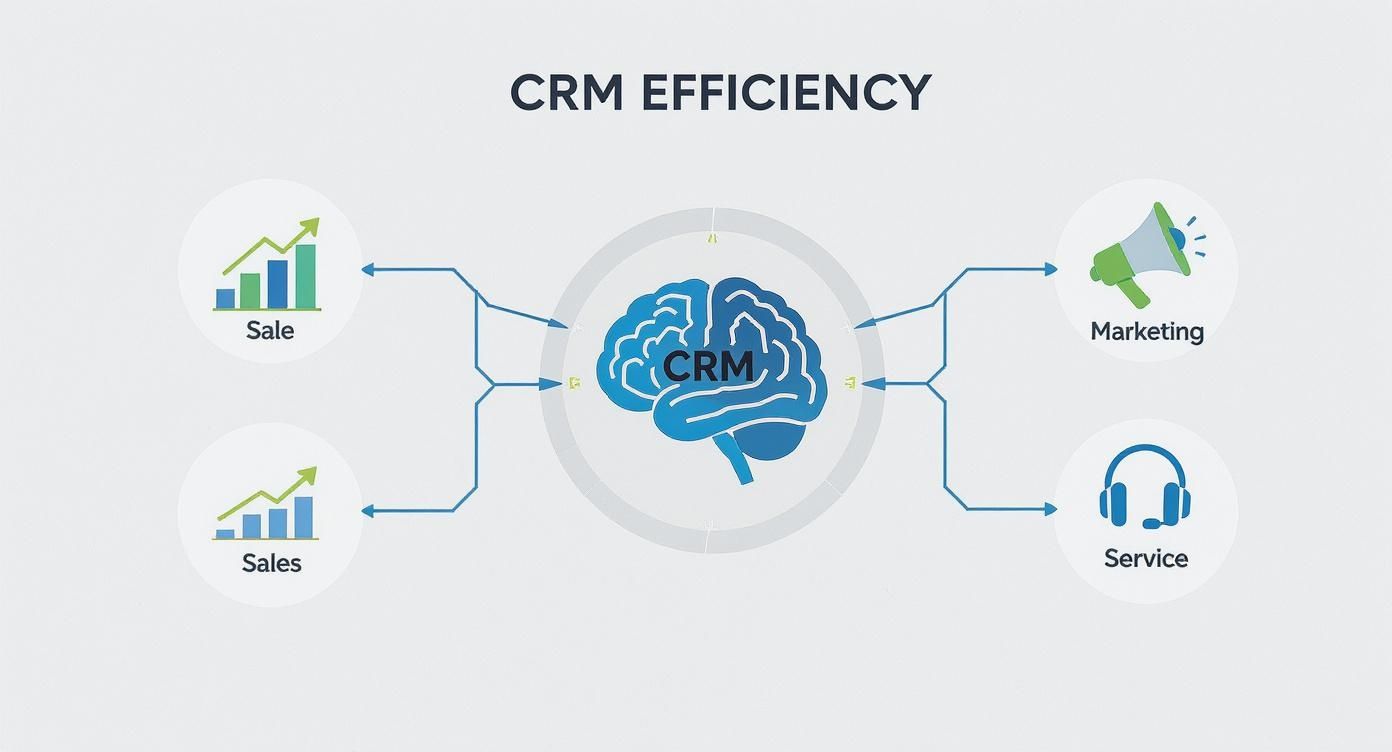
It makes it clear that a CRM isn’t meant to be an island. Its true power is unlocked when it becomes the single source of truth that every customer-facing team can depend on.
RevOps Engineering as the Solution
To really hit the strategic goals of crm, you need to treat your tech stack with the seriousness it deserves. That means ditching the fragile, one-off integrations and adopting a proper engineering mindset.
A RevOps engineer is focused on the deep, foundational work:
- Schema Design: Intentionally planning how data is structured in your CRM from the get-go. This makes reporting, automation, and analysis infinitely easier down the road.
- Bi-Directional Syncs: Making sure that when a record is updated in one place (like Salesforce), that change is instantly and accurately reflected everywhere else (like your data warehouse). No more stale data.
- Observability: Building dashboards and alerts to monitor the health of your data pipelines. This lets you spot and fix issues before they start causing problems for the business.
This is the discipline that elevates a CRM from a simple database into a genuine strategic weapon. By getting the data foundation right, RevOps engineering gives every team the confidence to trust the information they see. That trust is what makes it possible to automate complex workflows, personalize customer outreach, and ultimately, crush your biggest business goals.
How to Measure Your CRM Success
A goal without a number is just a wish. After you’ve laid out your strategic, operational, and customer-focused goals, the real work begins: turning those ambitions into cold, hard data. Success isn’t just about feeling more organized; it’s about proving the tangible return you’re getting from your CRM investment.
But first, you have to get everyone on the same page. True CRM success is a team sport. It demands company-wide buy-in and proper training, because if your teams don’t understand why they’re using the tool and how it helps them, adoption will tank. Once you have that alignment, the next step is connecting each of your core CRM goals to Key Performance Indicators (KPIs) you can actually track.
Linking Goals to Actionable KPIs
To really measure success, you need to draw a straight line from your high-level objectives to the specific metrics that prove you’re hitting them. This takes the guesswork out of the equation and gives you a clear dashboard for seeing what’s working and what isn’t.
For instance, if your main goal is to drive sales growth, don’t just stare at the final revenue number. You need to dig into the leading indicators that show whether your sales process is actually getting healthier.
Here are the core KPIs to watch for each primary CRM goal:
-
For Sales Growth: Keep a close eye on your Lead-to-Opportunity Conversion Rate. This number tells you how good your team is at turning initial interest into serious sales conversations. You’ll also want to monitor the Average Sales Cycle Length to see if your new processes are helping reps close deals faster.
-
For Customer Loyalty: Your North Star here is the Customer Churn Rate. Nothing says “we’re doing it right” like a declining churn rate. Pair that with Customer Lifetime Value (CLV) to understand the total long-term worth of your happy, loyal clients.
-
For Operational Efficiency: Look at metrics like Average Ticket Resolution Time for your support team—a lower number means problems are getting solved faster. For sales, try to estimate the Time Spent on Manual Data Entry through user surveys and activity logs. Reclaiming that time is a huge efficiency win.
Be careful not to fall into the trap of tracking “vanity metrics”—those numbers that look impressive on a slide but don’t actually signal business health. Stick to a handful of KPIs directly tied to revenue, retention, and cost savings to prove undeniable ROI.
A Practical Framework for Tracking ROI
To make this crystal clear, we’ve put together a table that maps each primary CRM goal to its most critical KPIs. It explains exactly what each one measures so you can stop guessing and start knowing.
Use this as a starting point to build your own CRM success dashboard. It’s the perfect tool for demonstrating the powerful impact of a well-run system.
Mapping CRM Goals to Measurable KPIs
A practical guide to tracking the success of your CRM strategy by connecting high-level goals to specific, actionable KPIs.
| CRM Goal | Key Performance Indicator (KPI) | What It Measures |
|---|---|---|
| Drive Sales Growth | Lead-to-Opportunity Conversion Rate | The percentage of qualified leads that become active sales opportunities. |
| Drive Sales Growth | Average Sales Cycle Length | The average time it takes to close a deal from first contact to signed contract. |
| Build Customer Loyalty | Customer Churn Rate | The percentage of customers who stop doing business with you over a specific period. |
| Build Customer Loyalty | Customer Lifetime Value (CLV) | The total revenue your business can expect from a single customer account. |
| Improve Efficiency | Average Ticket Resolution Time | The average time it takes for your support team to resolve a customer issue. |
| Improve Efficiency | User Adoption Rate | The percentage of your team that is actively and consistently using the CRM platform. |
By keeping these metrics front and center, you’re not just implementing a CRM—you’re building a data-driven engine for growth that you can fine-tune over time.
Still Have Questions About CRM Goals?
Getting your head around a new CRM strategy can feel a bit overwhelming, so let’s tackle a few common questions that pop up.
What’s the Real Point of a CRM, Anyway?
When you boil it all down, the main goal of any CRM is to create a single, unified view of every single customer. Think of it as the ultimate playbook for your business.
This single source of truth means your sales, marketing, and service teams are all working from the same page, which helps them build real relationships, close more deals, and just get things done more efficiently.
How Do I Figure Out the Right CRM Goals for My Business?
It’s tempting to want to do everything at once, but the best approach is to start with your biggest headaches. Where is the business bleeding? Are you struggling to keep track of leads? Is customer churn higher than you’d like?
The most powerful goals of crm are the ones that directly tackle your most urgent problems.
A CRM isn’t just another piece of software; it’s a core part of your business strategy. Tie its goals directly to what you’re trying to achieve as a company—whether that’s grabbing more market share or keeping customers happy—and you’ll see a real return on your investment.
Is a CRM Worth It for a Small Business?
Absolutely. Don’t let the “enterprise” talk fool you—CRMs are a massive advantage for small businesses.
It can be a total game-changer for getting your customer data organized, automating all those little repetitive tasks, and delivering the kind of personalized service that turns one-time buyers into lifelong fans.
If your CRM goals need more than just out-of-the-box features—like custom data pipelines or tricky integrations—RevOps JET offers on-demand revenue operations engineering to build the solid foundation you need. Learn how we build the technical backbone for your CRM strategy.